Tampilkan postingan dengan label gears. Tampilkan semua postingan

Minggu, 22 Juni 2008

basic of gears work

How Gears Work

by Karim Nice

Inside this Article

  1. Introduction to How Gears Work
  2. Basics
  3. Spur Gears
  1. Helical Gears
  2. Bevel Gears
  3. Worm Gears

Basics

On any gear, the ratio is determined by the distances from the center of the gear to the point of contact. For instance, in a device with two gears, if one gear is twice the diameter of the other, the ratio would be 2:1.

One of the most primitive types of gears we could look at would be a wheel with wooden pegs sticking out of it.


Figure 1. Animation of peg wheel gear

The problem with this type of gear is that the distance from the center of each gear to the point of contact changes as the gears rotate. This means that the gear ratio changes as the gear turns, meaning that the output speed also changes. If you used a gear like this in your car, it would be impossible to maintain a constant speed -- you would be accelerating and decelerating constantly.

Many modern gears use a special tooth profile called an involute. This profile has the very important property of maintaining a constant speed ratio between the two gears. Like the peg wheel above, the contact point moves; but the shape of the involute gear tooth compensates for this movement. See this section for details.

Now let's take a look at some of the different types of gears.

Gears


Photo courtesy
Emerson Power Transmission Corp.

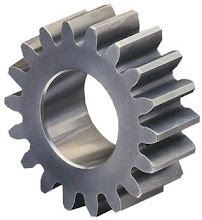
Gears are found in everything from cars to clocks. See more pictures of gears.

Gears are used in tons of mechanical devices. They do several important jobs, but most important, they provide a gear reduction in motorized equipment. This is key because, often, a small motor spinning very fast can provide enough power for a device, but not enough torque. For instance, an electric screwdriver has a very large gear reduction because it needs lots of torque to turn screws, but the motor only produces a small amount of torque at a high speed. With a gear reduction, the output speed can be reduced while the torque is increased.

Another thing gears do is adjust the direction of rotation. For instance, in the differential between the rear wheels of your car, the power is transmitted by a shaft that runs down the center of the car, and the differential has to turn that power 90 degrees to apply it to the wheels.

There are a lot of intricacies in the different types of gears. In this article, we'll learn exactly how the teeth on gears work, and we'll talk about the different types of gears you find in all sorts of mechanical gadgets.

­